
Case Study
IoE Case Study Ryanair
Ryanair is widely regarded as a prime example of radical business model innovation. This case study explores how the low-cost carrier redefined an entire industry through efficiency, standardisation, and the add-on model – and what principles founders can draw from it.

The Rise of Ryanair – From Regional Challenger to European Market Leader
Ryanair was founded in 1984 by Tony Ryan, Liam Lonergan and Christopher Ryan in Ireland, initially launching as a small regional airline operating between Waterford and London. In the early 1990s, inspired by the low-cost model of Southwest Airlines in the United States, Ryanair underwent a radical strategic transformation under the leadership of Michael O'Leary: moving away from traditional full-service operations towards an uncompromising low-cost carrier model. The goal was to make air travel affordable for the general public whilst challenging established airlines with an aggressive pricing and efficiency strategy. Today, with over 150 million passengers annually, Ryanair is one of Europe's largest airlines, renowned for its extremely low ticket prices, high flight frequency and a disruptive business model that has fundamentally reshaped the industry.
Business Model Innovation: What Makes Ryanair Special?
The success of Ryanair is built on the consistent application and combination of several business model patterns, which the Business Model Navigator regards as prime examples of disruption and efficiency:
a) Add-On
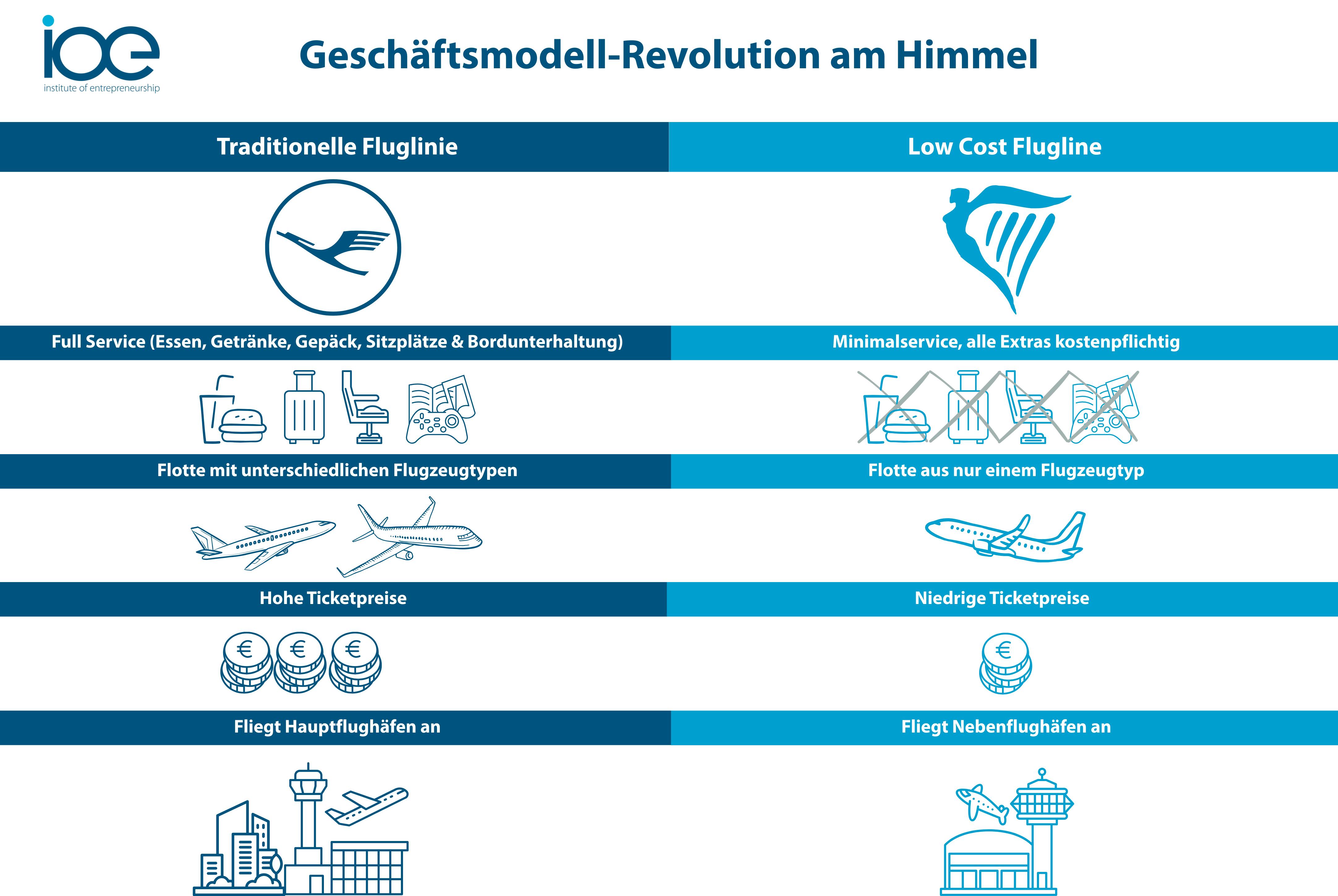
At the heart of the Ryanair model is the add-on approach — a radical separation between the base price and additional services: the entry price for a ticket is extremely low, often below competitors' costs. All further services, from seat selection and baggage to snacks and drinks, are offered as paid add-ons. This model maximises load factors, opens up new customer segments, and makes it possible to attract even price-sensitive customers, while additional services are monetised in a targeted way.
b) Direct Selling
Ryanair distributes its tickets via direct selling – almost exclusively through its own website and app. This eliminates commissions to travel agencies and third-party providers, optimises margins, and strengthens the direct customer relationship. At the same time, Ryanair can strategically manage cross-selling offers (e.g. car hire, hotels, insurance) and generate additional revenue.
c) No Frills
No Frills at Ryanair means that the on-board offering is reduced to the absolute minimum: no complimentary food, no entertainment, no free extras. The focus is exclusively on the safe and efficient transportation of passengers from A to B. Processes are maximally standardised and streamlined to minimise costs.
d) Cost Leader
Ryanair positions itself uncompromisingly as Europe's lowest-cost airline, pursuing a strategy of cost leadership. Every operational decision is aligned with efficiency and cost optimisation. Two key levers are particularly worth highlighting:
Secondary airports: Ryanair preferentially operates from smaller, less busy airports that charge significantly lower fees than major hubs. This not only reduces costs but also enables faster turnaround times and higher flight frequency.
Standardised fleet: Ryanair's fleet consists almost exclusively of aircraft of the same type (Boeing 737). This significantly simplifies maintenance, repairs, spare parts management and crew training, further reducing costs.
e) Cross Selling
Ryanair deliberately leverages its platform to go well beyond pure ticket sales, offering additional, high-margin products and services. Through this cross-selling approach, car hire, travel insurance, and airport transfers at the destination are made available via its own website and app — often directly within the booking process or through targeted follow-up campaigns. By maintaining direct control of the customer relationship, Ryanair can personalise offers, select partners, and optimise commissions. At the same time, the platform becomes the customer's central point of contact for the entire journey, increasing loyalty and generating additional data for further monetisation.
f) Hidden Revenue
A decisive success factor in the Ryanair model is the generation of "hidden revenue" — income that is not immediately recognisable as such. This includes, for example, fees for certain payment methods, priority boarding, or the targeted marketing of advertising space on boarding passes, in the aircraft, or on the website. Revenue from partnerships with airports or local service providers also falls into this category. These hidden revenue streams are often not included in the base price, but are actively communicated and priced in throughout the customer journey. For Ryanair, they are a central lever for achieving high profitability despite low ticket prices, and for differentiating itself from traditional airlines.
g) Self-Service
Ryanair has consistently applied the self-service principle to every customer touchpoint. From booking and check-in through to baggage drop-off and boarding, as many processes as possible have been digitalised and converted to self-service. Customers carry out online check-in themselves, print boarding passes or download them to their smartphones, drop off luggage at automated kiosks, and receive primarily digital support via FAQs or chatbots when they have questions. This model reduces staffing requirements, cuts costs, and speeds up processes both at the airport and in administration. At the same time, customers become accustomed to digital processes, which increases scalability and further enhances the efficiency of the overall business model.
What can you learn from Ryanair's business model?
The development of Ryanair offers numerous practical insights for you:
- Radical focus on what matters: those willing to limit their offering to its core value and consistently optimise for efficiency can unlock new price points and target audiences even in saturated markets.
- Separating core services from additional offerings: the add-on model allows you to attract price-sensitive customers whilst simultaneously monetising through optional extras in a targeted way.
- Direct customer relationships as a competitive advantage: Through direct selling and self-service, the value chain can be shortened, margins increased, and customer loyalty strengthened.
- Cost reduction through standardisation and process innovation: The focus on a uniform fleet and the use of more cost-effective locations (secondary airports) are prime examples of strategic cost leadership.
- Leveraging cross-revenue and hidden revenue streams strategically: Those who systematically develop add-on products and untapped revenue sources not only boost profitability, but also reduce their dependence on price competition in their core business.
Conclusion
Ryanair demonstrates compellingly how the consistent application of modern business model patterns can drive sustainable growth and disruptive success. For entrepreneurs and decision-makers, the willingness to radically challenge established industry logic and to rethink one's own offering without compromise opens up new opportunities for differentiation and scaling — even in mature markets.
Find out how you can apply these principles to your own business model – in a personal conversation with the IoE experts.