
Article
Comprehensive Checklist for Buying a Business: A Guide for Prospective Buyers
Acquiring an existing business is a proven way to enter entrepreneurship or expand your portfolio. Compared to starting from scratch, the buyer benefits from established structures, an existing customer base, and a business model that is already up and running. This checklist provides you with structured, practical guidance through the key phases of a business acquisition – from defining your strategic objectives and conducting a systematic search and due diligence, through to successful integration.

1. Preparation Phase: Mindset, Strategy and Investment Thesis
Before considering the purchase of a business, you should go through a thorough preparation phase. This phase is crucial for gaining clarity about your objectives and the framework conditions for the acquisition.
1.1 Motives ("Buying Instead of Starting")
Ask yourself why you want to buy a business:
- Would you like to enter a new market?
- Are you looking for synergies with your existing business?
- Do you want to restructure a company, or support a growth business?
Wealth creation: View buying a business as a long-term investment in your financial independence and as a vehicle for building scalable wealth.
- Is building wealth and securing your financial independence your primary goal?
A clear definition of your objectives helps you to structure the selection of potential target companies and make the search more efficient.
1.2 Attitude, Aptitude, Action: Personal Prerequisites
- Attitude: Do you bring the right entrepreneurial mindset – a willingness to take risks, curiosity, and a sense of responsibility?
The right entrepreneurial mindset is a fundamental prerequisite for a successful business acquisition. You should be aware that entrepreneurial action always involves uncertainty and risk. Openness to new ideas, a willingness to take responsibility, and a high degree of initiative and perseverance are essential. Only those who are prepared to act with a solution-focused approach even in challenging situations, and to view setbacks as opportunities to learn, will achieve long-term success as a business owner.
- Aptitude: Assess your professional expertise and management skills. Where do your strengths lie, and which competencies do you need to bring in through your team?
Critically assess your professional and personal competencies before entering the acquisition process. This includes business management knowledge as well as industry expertise, leadership experience, and communication skills. Consider where your own strengths lie and where you will need targeted support from external experts or a strong team. A realistic appraisal of your own abilities helps you identify risks early and address them proactively.
- Action: Find your right role and direction
Before you decide to acquire a business, ask yourself: What does your ideal working day look like? Which activities engage you so deeply that you lose all track of time? This personal sense of purpose is essential when it comes to finding the right business and the right entrepreneurial role for you.
In the day-to-day life of an entrepreneur, there are two core areas of responsibility:
- Growth and Sales: Does your strength lie in winning new clients and expanding the business?
- Operational Excellence: Or are you more drawn to optimising processes and running the business efficiently?
Reflect honestly on where your natural strengths and preferences lie. Successful entrepreneurs need to understand both sides – but you should focus your energy particularly where you feel long-term motivation and drive. Use this insight to actively seek out businesses that align with your personal strengths and inclinations.
Anyone planning to acquire a business should take time beforehand to reflect carefully on their personal motivations – these form the foundation for every subsequent step. Find out more about the motivations behind buying a business!
1.3 Market and Industry Analysis
A thorough market and industry analysis is a key success factor when acquiring a business. The goal is to develop a deep understanding of the dynamics, opportunities, and risks of the target market, and to critically assess the long-term viability of the business model. To achieve this, systematically analyse current market trends, the competitive landscape, and the relevant regulatory framework. Pay particular attention to the structure and stability of customer and supplier relationships, barriers to entry, and technological developments that could impact the business model. Supplement your analysis with industry reports, trade association studies, and conversations with sector experts to gain a realistic picture of the market's attractiveness and the target company's future potential. A careful examination of these factors lays the foundation for a well-informed investment decision and minimises the risk of unexpected market developments.
- Has the market and industry attractiveness of the target company been comprehensively assessed using relevant data and external sources?
A thorough understanding of the relevant industries in business acquisitions is essential for accurately assessing opportunities and risks.
1.4 Opportunity Profile & Exit Scenario
The four opportunity profiles in business acquisition:
When acquiring a business, choosing the right opportunity profile is crucial. Every business offers different opportunities and challenges – from stable, profitable business models to turnaround cases, through to growth or platform businesses. Selecting the profile that best matches your own goals and strengths lays the foundation for lasting success.
- Eternally Profitable (Dauerhaft profitabel): Stable, slow-growth businesses with consistent demand and low disruption risk. Ideal for security-minded buyers who prioritise reliable cash flows.
- Turnaround: Companies with operational or financial difficulties that can be returned to profitability through restructuring and efficiency improvements. Suitable for turnaround specialists with hands-on operational experience.
- High Growth: Companies with strong revenue and profit growth. Attractive to buyers seeking expansion and scalability – but with increased risk due to high purchase prices and capital requirements.
- Platform: Solid businesses with potential for targeted value enhancement through your own strengths (e.g. sales, digitalisation) or as a foundation for further acquisitions. Ideal for strategically minded entrepreneurs.
- Have you chosen the Opportunity Profile that best matches your entrepreneurial goals, risk appetite, and operational capabilities?
Exit Plan/Scenario: Define in advance how your investment might conclude (e.g. long-term holding, strategic sale, transfer to a successor). This sharpens your investment rationale and provides guidance for future decisions.
- Have you already defined a clear exit scenario to guide your investment strategy?
1.5 Investment Thesis
Formulate a precise hypothesis as to why this particular target company offers you the greatest value. Consider the following:
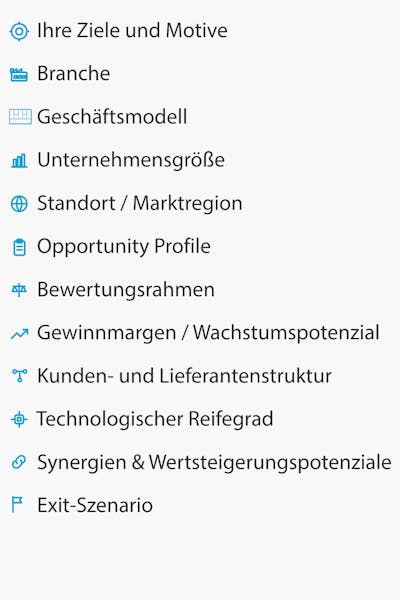
- Have you formulated a clear investment thesis that explains why this company is a strategic and economic fit for you?
2. Search & Selection Phase: Systematic Identification and Outreach
The next step is to find a suitable business. Various sources and approaches can be used to do so.
2.1 Search Strategies and Market Approach
Network activation: By strategically engaging your personal network – through contacts, industry events or specialist forums, for example – you can unlock additional acquisition opportunities that are often hidden from view.
Online platforms for business sales provide you with a structured overview of available listings and support the screening of potential target companies through digital channels.
M&A advisers and business brokers: they provide access to exclusive business listings and guide you professionally through the acquisition process – though you should always keep in mind that these intermediaries have their own interests to consider.
Direct approach to potential target companies: Enables you to identify businesses that are not officially listed on the market, through independent research and proactive outreach.
- Have you chosen the right search channel to match your target industry, market region, and strategy?
A key success factor is the systematic identification of suitable target companies. The right search strategy and market approach when acquiring a business ensures that you find the right candidates and make contact successfully. Once you have identified an initial selection of potential companies, the question arises: which candidates are genuinely attractive – and which risks should you recognise early on? You will find a practical guide to criteria, positive indicators, and red flags in our article "What makes a good target company".
2.2 Initial Contact and Qualification
Initial meeting with sellers: clarifying interests, expectations, and reasons for selling. Building trust and gaining an understanding of the business situation.
An initial conversation with the business sellers serves to clarify the respective interests, expectations and motivations behind the sale. The aim is to build a relationship of trust and gain an initial understanding of the company's current situation. Even at this early stage, you should ask targeted questions about the reasons behind the intention to sell, the key success factors and potential challenges.
- Have you clarified the seller's interests and reasons for selling in the initial meeting, and established a basis of trust?
Confidentiality Agreement (NDA): Ensuring the protection of information prior to deeper insights.
To ensure that sensitive information is handled professionally, it is advisable to put a confidentiality agreement (NDA) in place before granting deeper access to company data.
- Was a confidentiality agreement (NDA) signed before receiving sensitive information?
2.3 Information Gathering and Company Presentation
Information Memorandum (IM): Requesting and reviewing initial company documents.
In the next stage, you request a detailed information memorandum (IM) that summarises the key metrics, structures, and business models of the target company. These documents enable an initial well-founded assessment of the company's attractiveness and risks.
- Have you requested a complete information memorandum and systematically assessed it for opportunities and risks?
Management meetings: In-person meetings with owners and management to deepen mutual understanding and assess personal chemistry.
This should be followed by in-person meetings with management and the owners to address any outstanding questions and assess the company culture as well as the personal chemistry between the parties. Direct, face-to-face dialogue is essential for building trust and validating the credibility of the information presented.
- Were there personal management meetings to clarify open questions and assess mutual compatibility?
2.4 Letter of Intent (LOI)
LOI Negotiation: Drafting a non-binding letter of intent covering key terms such as purchase price, structure, timeline, and exclusivity.
Following a successful preliminary review and positive assessment of the initial information, the parties proceed to drafting and negotiating a Letter of Intent (LOI). The LOI sets out the key parameters of the intended acquisition – including the purchase price, payment terms, timeline, and exclusivity arrangements. Although the LOI is generally non-binding from a legal standpoint, it provides both parties with planning certainty and a clear framework for the subsequent due diligence process. Any reservations or outstanding points are also addressed transparently at this stage, in order to avoid misunderstandings further down the line.
- Have you negotiated and documented an LOI with clear parameters covering purchase price, structure, timeline, and exclusivity?
2.5 Preliminary Review ("Red Flags Check")
Initial risk identification: high-level analysis of key metrics, contracts, and potential deal-breakers prior to entering due diligence.
Before embarking on a comprehensive due diligence process, a structured preliminary review is advisable — the so-called Red Flags Check. This involves subjecting key metrics, contracts, and potential deal-breakers to an initial high-level analysis. The aim is to identify critical risks at an early stage, such as unresolved legal disputes, significant revenue declines, or problematic customer concentrations. This allows you to avoid investing unnecessary resources in unpromising transactions and to focus your attention on viable target companies.
- Were potential deal-breakers identified and assessed at an early stage through a structured preliminary review (Red Flags Check)?
3. Review Phase: Due Diligence
Due diligence is one of the most critical steps in the entire business acquisition process. At this stage, all key information and metrics of the company are examined in order to identify potential risks and validate the purchase price.
3.1 Financial Due Diligence
Review the company's financial records for the past three to five years. Pay particular attention to the following aspects:
Balance sheet and profit & loss statement: Are there any unexpected liabilities or outstanding payments?
Cashflow analysis: How stable is the revenue and what seasonal fluctuations are there
Liabilities and obligations: Are all loans and leasing agreements transparently and properly documented?
Please note that an experienced financial adviser or auditor is essential for this analysis.
- Have you reviewed the financial records of recent years for stability, liabilities, and cash flow risks – ideally with the support of a financial adviser?
3.2 Legal Due Diligence
Review the legal framework and contracts of the business. This includes:
Existing contracts: Review key supplier contracts, customer agreements, and lease agreements.
Legal disputes: Are there any ongoing or potential lawsuits pending?
Licence rights and patents: Does the company hold protected intellectual property?
A specialised lawyer should carefully review all legal documents.
- Have all material contracts, legal obligations and potential disputes been reviewed by a specialist lawyer?
3.3 Tax Due Diligence
The tax review covers the analysis of tax obligations, outstanding liabilities, and any potential tax risks. It is essential to verify that the business has complied with all tax regulations, so that no unpleasant surprises arise after the acquisition.
- Have tax obligations, risks, and outstanding claims been comprehensively analysed by a tax expert?
3.4 Operational and Technological Due Diligence
Review the company's operational processes and technological infrastructure. This includes:
Production processes: Are the production capacities scalable and efficient?
Technological infrastructure: Does the company have modern IT systems that keep it competitive?
Supply chains and inventory management: How stable and resilient are the supply chains, particularly during times of crisis?
A thorough operational due diligence carried out by specialist advisors can also be highly beneficial in this process.
- Have you reviewed your processes, IT infrastructure, and supply chains for efficiency, scalability, and future-readiness?
4. Negotiation Phase: Striking the Deal
After the due diligence, negotiations on the purchase price and contract terms begin.
4.1 Purchase Price and Financing Structure
Based on the results of the due diligence, you are now in a position to negotiate the purchase price. Bear in mind that the purchase price does not always have to be paid in a single lump sum. Earn-out models or instalment payments are frequently agreed upon, whereby a portion of the purchase price is tied to the future performance of the business.
- Has the purchase price been negotiated on the basis of the due diligence, and have potential earn-out models or instalment payment arrangements been taken into account?
Alongside the purchase price and financing, the total costs of a business acquisition should be realistically factored in. A well-founded business valuation is the basis for any price negotiation.
4.2 Contract Drafting
A professionally drafted purchase agreement is essential to avoid potential future disputes. The contract should include the following points:
Detailed description of the purchase object: What exactly is being acquired (e.g. shares, assets)?
Warranties and guarantees: The seller should be liable for certain company data (e.g. financial figures, customer contracts).
Conditions of the handover: defining handover procedures and potential support by the seller during the transition phase.
- Have you drawn up a professional purchase agreement that clearly and in detail sets out the subject matter of the purchase, warranties, guarantees, and handover conditions?
A key success factor is choosing the right deal structure, one that takes into account the relevant tax, legal, and financial framework conditions.
4.3 Closing Financing Negotiations
Finalise negotiations with banks and investors to secure your funding. Ensure that all financial commitments are in place in good time before the purchase agreement is signed.
- Are all financing commitments from banks and investors in place and secured at the time of signing the contract?
5. Completion and Integration: The First Step Into the Future
After the contract is signed, the transition and integration phase begins. This phase is crucial for long-term success.
5.1 Transition Management
After the contract is signed, the critical phase of transition management begins. During this phase, it is essential to develop a clear and structured integration plan that ensures a smooth handover of management responsibilities and the operational and strategic alignment with your existing structures. Particular emphasis should be placed on transparent and timely communication with all relevant stakeholders – especially employees, senior staff, customers, and suppliers. The goal is to minimise uncertainty, build trust, and maintain high levels of motivation within the team. It is advisable to actively involve key individuals in the integration process and to address any concerns openly. A well-considered transition management approach lays the foundation for a successful working relationship and the sustainable development of the acquired business.
- Is there a clear integration plan in place that structures the business acquisition and ensures transparent communication with all relevant stakeholders?
5.2 Post-Merger Integration
Post-merger integration is critical to realising the synergy potential identified in advance and achieving sustainable value creation across the combined entity. During this phase, the focus is on deliberately harmonising processes and structures, eliminating redundancies, and capturing efficiency gains. Cultural integration is just as central as operational integration: differing corporate cultures and ways of working must be brought together to prevent conflict and establish a shared understanding of the organisation's future direction. Continuous monitoring of progress against targets, combined with the flexible adjustment of integration measures, is essential to respond effectively to unforeseen challenges and ensure the integration process delivers lasting success.
- Have measures for process harmonisation, cultural integration, and continuous monitoring of goal achievement been implemented?
After the purchase agreement is signed, integration determines long-term success – the first 100 days following an acquisition are particularly critical.
Conclusion
Buying a business is a demanding undertaking that requires careful planning, comprehensive analysis, and strategic negotiation. Once the acquisition is complete, integration begins – read how to manage the transition successfully in Post-Acquisition Integration. With the right preparation and the support of experienced advisors, however, you can minimise risks and benefit from the many advantages that come with acquiring a business. This checklist serves as a guide to help you navigate the process in a structured and successful way.