
Case Study
IoE Case Study Airbnb
Airbnb fundamentally transformed the travel market through a platform and peer-to-peer model. This article explores how the company leverages trust, data, and community as strategic success factors – and what founders can learn from it.

The Story of Airbnb – From Makeshift Solution to Global Platform
In 2007, Brian Chesky and Joe Gebbia found themselves in San Francisco facing a problem many founders know all too well: tight finances, high rents, and little prospect of improvement. Their spontaneous idea of renting out air mattresses in their flat to conference visitors laid the foundation for a business model that would fundamentally transform the global travel and hospitality industry within just a few years. Together with Nathan Blecharczyk, they founded Airbnb in 2008 – a platform that enables private individuals to rent out all kinds of accommodation to guests from around the world.
What began as an improvised solution has become synonymous with the "sharing economy". Today, Airbnb connects millions of accommodation options in almost every country and region, from a simple sofa to a luxury villa. The platform stands for flexibility, authenticity and the democratisation of travel, while at the same time fundamentally challenging the traditional market dynamics of the hotel industry.
Business Model Innovation: What Makes Airbnb Special?
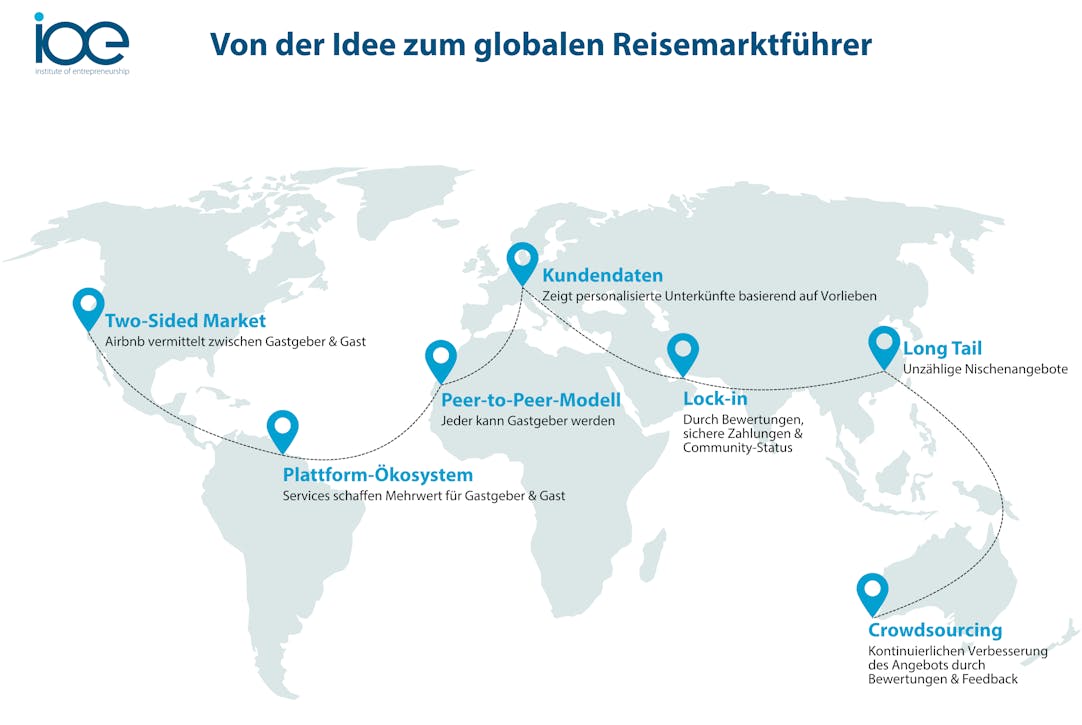
The innovative power of Airbnb lies in the consistent combination of several business model patterns, as described in the Business Model Navigator. The following section provides a detailed analysis of the key aspects:
a) Two-Sided Market – Matching Supply and Demand
Airbnb operates as a classic two-sided marketplace: on one side, it engages hosts — both private individuals and professional providers — who make their accommodation available. On the other side, it targets travellers looking for flexible, personalised, and often more affordable alternatives to hotels. The platform acts as an intermediary, building trust through features such as reviews and payment processing, while earning a share of every transaction.
b) Platform – Ecosystem for Hosts, Guests and Third-Party Providers
Airbnb is far more than a simple booking platform — the company has created a highly interconnected digital ecosystem that brings together hosts, guests, and numerous third-party providers, generating value on multiple levels.
- Hosts benefit from intuitive tools for managing their listings, dynamic pricing, automated calendars and integrated communication, giving them access to global demand they could never reach on their own.
- Guests, in turn, are supported by intelligent search and recommendation systems, transparent reviews, and streamlined booking processes, giving them access to a wide range of options – from affordable private accommodation to exclusive luxury villas – enabling a truly personalised travel experience.
- Third-party providers such as insurers or payment service providers are integrated into the platform ecosystem, creating additional services around the core offering.
Airbnb's platform model generates strong network effects: the more hosts list their properties, the more attractive the platform becomes for guests – and vice versa. As the user base grows, so does the volume of data available, enabling continuous improvements to algorithms for search recommendations, price optimisation, and fraud prevention. The platform structure also allows Airbnb to enter new markets and segments with comparatively little additional effort, as the technological infrastructure and processes are provided centrally.
The platform also encourages interaction and exchange — through features such as reviews, Superhost programmes, and host communities — creating a vibrant, self-reinforcing ecosystem. The platform model allows Airbnb to generate value at multiple levels.
c) Peer-to-Peer – Democratisation and Decentralisation of Supply
The peer-to-peer model sits at the heart of Airbnb's DNA: anyone can become a host, anyone can be a guest. This radical opening of the market enables a previously unimaginable variety of accommodation options and experiences. Decentralisation drives enormous scalability and makes Airbnb largely independent of its own assets.
d) Leverage Customer Data – Using Data for Optimisation and Monetisation
The principle of Leverage Customer Data sits at the heart of Airbnb's digital value creation: Airbnb collects and analyses extensive data on booking behaviour, user preferences, and interactions between users. This data is used in a targeted way to deliver personalised recommendations, adjust prices dynamically, minimise fraud attempts, and continuously improve the overall platform experience. The intelligent application of the Leverage Customer Data approach is a key driver of growth, efficiency, and the development of new revenue streams.
e) Lock-in – User Retention Through Trust and Community
By deliberately applying the lock-in principle, Airbnb systematically invests in building user loyalty: verifications, transparent reviews, secure payment processing, and effective conflict management all contribute to a high level of trust and security. The community elements (e.g. Superhost status, personal profiles, testimonials) are an integral part of the lock-in strategy, as they strengthen emotional engagement and significantly increase switching costs for users.
f) Long Tail – Maximum Variety and Niche Offering
Airbnb is a prime example of the Long Tail principle in action: alongside classic holiday apartments and standard accommodation, the platform hosts countless niche offerings – from treehouses and houseboats to tiny houses. This diversity appeals to a wide range of target audiences and opens up new markets that would be virtually impossible to address through traditional hospitality.
g) Crowdsourcing – Innovation and Quality Improvement Through the Community
Airbnb harnesses the collective intelligence of its users: hosts and guests contribute to the continuous improvement of the offering through reviews, feedback, and user-generated content. New services and features are frequently developed and tested on the basis of user needs. The result is a self-reinforcing cycle of innovation.
What can you learn from Airbnb's business model?
The development of Airbnb offers numerous practical insights for entrepreneurs:
- Marketplace models create new markets: Acting as an intermediary between supply and demand via a digital platform makes it possible to disrupt existing market structures and unlock new value creation potential – even in industries with high barriers to entry.
- Platform and ecosystem thinking drives sustainable growth: those who systematically connect different stakeholders and create value for all parties establish themselves as an indispensable hub in the market.
- Peer-to-peer approaches democratise access: Opening up to new provider groups and niche offerings can drive exponential growth and minimise dependence on your own resources.
- Using data as a strategic resource: The intelligent analysis and use of customer data makes it possible to personalise your offering, optimise processes, and unlock new revenue streams.
- Community building and trust are key success factors: investments in security, transparency and user engagement pay off in the form of loyalty and positive word of mouth.
- Crowdsourcing as a driver of innovation: actively involving your users allows you to respond to trends more quickly and continuously improve the quality of your offering.
Conclusion
Airbnb demonstrates how the consistent application of modern business model patterns can lead not only to commercial success, but to a lasting revolution within an entire industry. For entrepreneurs and decision-makers, the lesson is clear: those who are willing to challenge established structures, leverage platform logic, and place community at the centre of their offering can unlock new growth opportunities even in saturated markets.
Learn how to apply these principles to your own business model – in direct conversation with the IoE experts.