
Article
Start-Up: From Idea to Scale – Your Path to a Successful Business Launch
A viable business model is the foundation of every successful venture. This article shows you how to systematically develop, test, and refine your idea into a market-ready business model – using methods such as the Business Model Canvas, the Business Model Navigator, and the Four Steps to the Epiphany.

From Idea to Entrepreneurial Reality
Many founders start out with an inspiring idea and a great deal of drive. Yet the real challenge begins only after that first flash of inspiration: how do you turn an idea into a viable, sustainable business model? Experience shows that founders who systematically develop, test, and align their business idea with market needs are far more likely to build a solid foundation for entrepreneurial success.
In the early stages of founding a business, many people face the same questions: Who are my customers? What problem am I actually solving? How can I turn my idea into a financially viable company? The following guidance offers orientation and shows you how to develop your idea step by step into a validated solution with real future potential. Many founders believe they have long since answered these questions — only to end up with a "finished" product that nobody wants. That is precisely why early validation is so important.
Understanding the Business Model – Key Questions and Building Blocks
A business model describes how a company creates value for customers, delivers that value, and generates revenue from it. It is the strategic foundation that determines long-term success – regardless of whether you are founding a technology start-up, a consultancy, or a retail business.
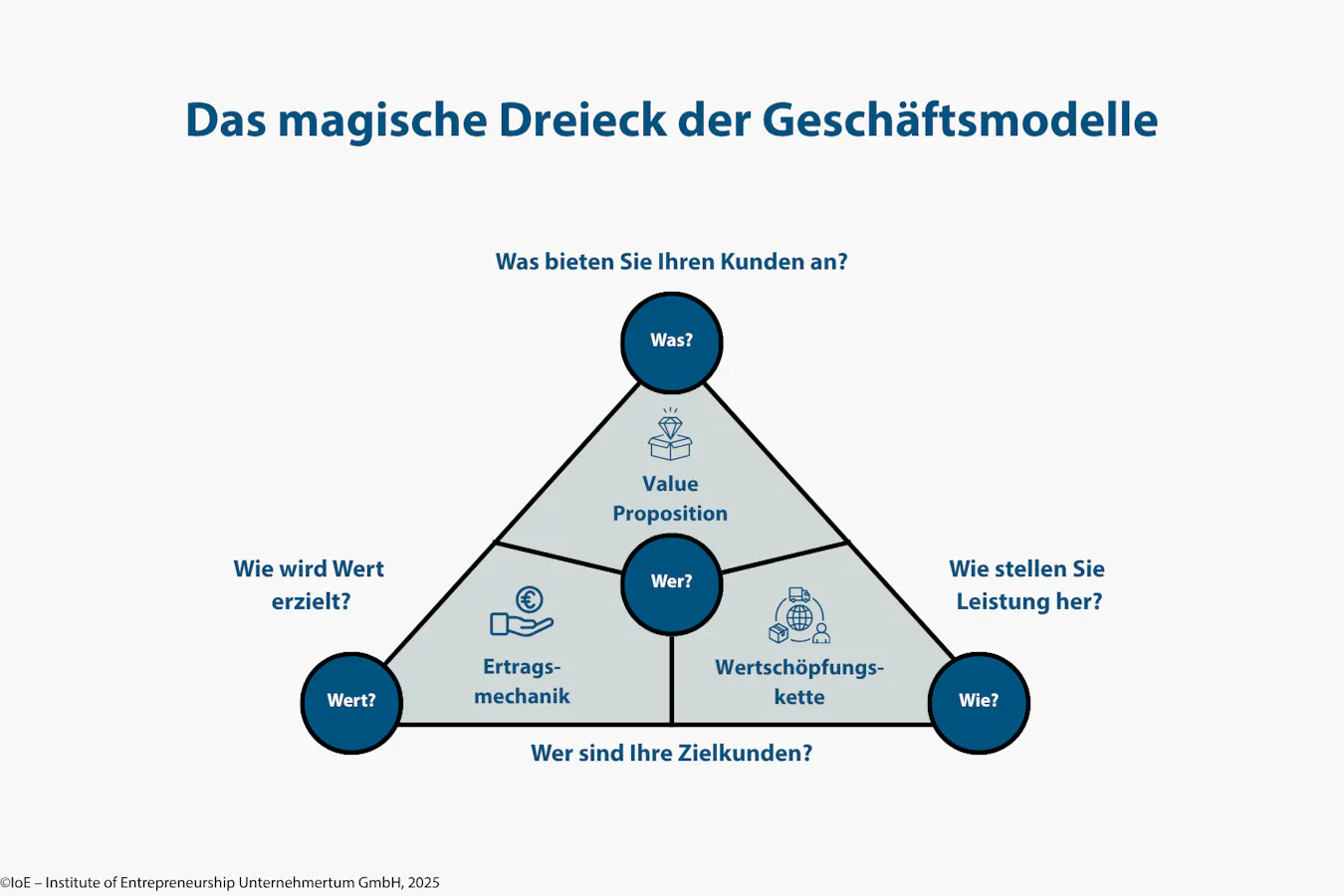
The four central guiding questions
- Who are your target customers?
Defining your customer segments precisely is the starting point for every successful business model. Who benefits most from what you offer? What specific needs, desires, or problems do these people have? A precise target audience analysis enables you to deploy resources effectively and develop offerings that are genuinely relevant. - What value do you offer?
At the heart of every business is the value proposition: what problem are you solving for your customers? Why is your offering better, faster, more affordable, or more convenient than existing alternatives? Successful founders don't think in terms of products — they think in terms of solutions to real customer problems. - How is value created and delivered?
This is about operational execution: What processes, technologies, and partners are needed to deliver your value proposition efficiently? How do you reach your customers – directly, through partners, or via digital platforms? What resources and capabilities are critical to making this happen? - Why is the business model economically viable?
Ultimately, what matters is whether the numbers add up: How will you generate revenue? Which pricing models and revenue streams are appropriate? How do costs and returns compare? Economic viability is the true test of any business model – and should be a central focus from the very beginning.
Different Types of Business Models
The variety of business models is enormous – and it is often tried-and-tested patterns that help companies achieve lasting success. The Business Model Navigator from the University of St. Gallen has identified 55 recurring business model archetypes used by the world's most successful companies. These patterns range from classic approaches such as the "Razor-and-Blades" model (core product cheap, consumables expensive) through to innovative concepts such as platform business models, freemium, subscription, and pay-per-use.
Each of these patterns answers the question of how companies create, deliver, and capture value – and can be used individually or in combination to challenge existing business models or develop new ideas.
The Architecture of a Business Model
A professionally developed business model comprises several interlocking building blocks. These include:
- Customer Segments: Who are your most important target groups?
- Value proposition: What makes your offer unique?
- Distribution channels: How does your product or service reach the customer?
- Customer relationships: How do you build trust and loyalty?
- Revenue streams: How do you make money?
- Key Resources: What do you need in order to deliver your offering?
- Key Activities: Which core processes are critical to success?
- Key Partners: Who do you work with to implement your business model efficiently?
- Cost structure: What costs are incurred, and how can they be optimised?
The Business Model Canvas (based on Osterwalder) structures the nine building blocks of a business model, while the Business Model Navigator provides inspiration through 55 patterns. Together, the two tools form a practical methodology for systematically developing and testing innovative business models.
Business Model Innovation as a Growth Driver
Innovative business models often emerge not from new products, but from new ways of creating and capturing value. Companies that challenge existing patterns and develop fresh approaches tend to be more successful in the long run. Examples such as platform models, subscription services, or the freemium principle illustrate how differently value can be created and monetised. Those willing to continuously question and evolve their model stay competitive and are well positioned to open up new markets.
Find out more about Business Model Innovation.
Test Your Business Model – From Assumption to Validation
Identifying and formulating hypotheses
Every business model is built on assumptions at the outset: about the customer, the problem, willingness to pay, or acceptance of the offering. The central task in the early stage is to validate these assumptions as quickly and efficiently as possible.
Customer feedback as the key
Direct dialogue with potential customers is the most effective way to test assumptions. The key lies in using the right questioning technique: rather than asking hypothetical questions ("Would you buy this?"), focus on concrete experiences and real behaviours. Questions such as "How do you currently solve this problem?" or "What are you spending money on today to address this problem?" yield reliable insights.
The Role of the Mom Test
Not all feedback is equally valuable. Rob Fitzpatrick's Mom Test shows how founders can use the right questions to obtain honest, reliable feedback – even from people who would otherwise simply tell them what they want to hear.
Learn more about the Mom Test and targeted feedback for your business model.
So you start! Experiment instead of guess
Instead of relying on gut feeling, you should run targeted experiments to validate your assumptions. These include:
- Customer interviews
- Prototyping (MVPs)
- Landing Pages
- Pre-sales or waiting lists
The Four Steps to the Epiphany
Steve Blank systematised this process in The Four Steps to the Epiphany:
1 - Customer Discovery – Formulating Hypotheses About Customers & Problems
The first step is to articulate and test your assumptions about customers, problems, and potential solutions. The goal is to develop a genuine understanding of your target audience, rather than remaining trapped in your own assumptions.
Practical tip: Seek out conversations with potential customers, observe their behaviour, and explore how they currently address existing problems.
2 - Customer Validation – verifying whether customers will actually buy
Once you have confirmed that the problem is real, it is time to test willingness to pay and market potential. This is where you find out whether your solution addresses a genuine need.
Practical tip: Run simple market tests – such as landing pages, pre-tests, or pre-orders – and measure the response.
3 - Customer Creation – Increasing Demand
In this phase, the validated offer is brought to market in a systematic way. Marketing and sales processes are scaled to generate predictable demand.
Practical tip: Define your go-to-market strategy. Which channels are most effective? How do you reach your target audience with minimal effort? Focus on repeatable, measurable processes.
4 - Company Building – Creating Structures
Now your startup evolves into a real business. You build teams, processes, and structures to make the validated business model sustainable in the long term.
Practical tip: Establish clear responsibilities, secure your resources, and develop stable organisational processes – from accounting and product management through to sales.
You start with the CPS hypothesis, develop a business model (Canvas + BMN), test it (Mom Test, experiments), build prototypes (Lean Startup), and document your findings in the Pitch Deck and Canvas.
Find out more about startups and how to turn your idea into a successful business!
Continuous learning and adaptation
No business model remains unchanged. The ability to learn quickly and respond flexibly to new insights is what determines success. Build a culture in which mistakes are seen as opportunities to learn. Use key metrics to measure progress and make decisions based on data.
Typical pitfalls and how to avoid them
- Developing in stealth for too long: Seek early contact with the market instead of spending months polishing a "perfect" product.
- Incorrect target audience focus: Regularly review whether you are reaching the right customers and truly understanding their needs.
- Resource waste: Opt for small, rapid experiments rather than large launches without market testing.
- Fear of adjustments: View course corrections as a sign of professionalism, not failure.
Outlook: Growth and Scaling
Once your business model has been validated and initial revenues are being generated, the next phase begins: scaling. This is where you align the model for growth, automate processes, and open up new markets. Stay open to innovation and regularly reassess your model – this is how you secure your long-term entrepreneurial success.
Conclusion – Your Next Step
Developing a viable business model is an iterative process: idea → hypothesis → test → validation → implementation → scaling. With tools drawn from the Business Model Navigator, Business Model Canvas, Four Steps to the Epiphany, and The Mom Test, founders have a proven methodology at their disposal to reduce risk and address genuine market needs.
➡️ Read more:
- Founding a Start-Up – Your Path from Idea to Execution
- The Mom Test: Validating Business Ideas Properly Instead of Sugarcoating Them
- Business Model Innovation: The Underestimated Lever